Of all the International Year of Astronomy's events, nothing matched the raw involvement of last April's 100 Hours of Astronomy, which showcased telescopes and other facilities around the world via nonstop online video streaming.
IYA has come and gone, but its heady buzz lingers. "I'd heard from all around that we needed to do something to keep the momentum going," says Mike Simmons, who co-chaired the 100HA effort. So Simmons brainstormed with others in an attempt to outdo what was arguably the single greatest outreach event in the history of astronomy.
During April, amateurs worldwide will be encouraged to participate in all kinds of events at small and large scales. At the local end will be the kinds of activities that fueled the worldwide interest in the night sky. "Most of the world's amateur astronomers engage mostly in public outreach and education," observes Simmons. "They've discovered the rest of the universe, and they want to share it with others." (As the founder of Astronomers Without Borders, the well-traveled Simmons certainly knows what he's talking about.)
Although 100HA announced local events, this time the hope is to establish more connections between activities and to provide a platform for showing off the results. For example, GAM's "broadcast channel" gives event organizers worldwide a place to show general-interest presentations, after-party highlights, and even live video streams.
For the Big Picture, organizers also have some Big Plans. There'll be repeats of successful activities like the 24-hour Global Star Party, along with more remote-observing events like January's highly successful "Big Dipper to South Pole" webcast — which despite little advance notice attracted more than 7,000 participants from 80+ countries.
Bold, new ideas are in the works as well. One is beautifully simple: a weeklong effort to observing the nightly changes in the Moon's position and phase using just your eyes. Another is a "Living Legend Series," featuring live interactive interviews with some of the most famous icons in amateur astronomy. (I could name names, but I'm sworn to secrecy!) You'll also see the inauguration of a major new effort in dark-sky awareness dubbed One Star at a Time.
There's much, much more in store — I can't cover it all here. (In fact, I emailed Simmons to get a couple of clarifications, and he sent me a 1,700-word response!). So check it out for yourselves, start thinking of how you can participate, and get ready to party!

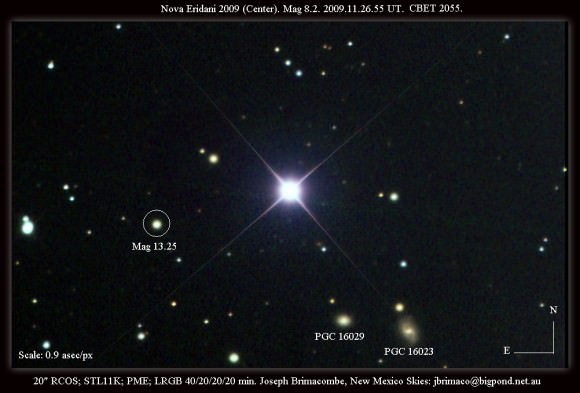
K. Itagaki of Yamagata, Japan was photographing the night sky in Eridanus two days ago when Hitoshi Yamaoka of Kyushu University noticed an anomaly – a possible classic nova event. Just how big a jump in amplitude did this star make? Try at least seven magnitudes within hours… and Joe Brimacombe was on it.
According to AAVSO Special Notice #181 released on November 25, 2009, there could be a possible nova in Eridanus. "Central Bureau Electronic Telegram No. 2050 (Daniel W. E. Green, Ed.) announces the discovery of a possible nova in Eridanus, as reported by Hitoshi Yamaoka, Kyushu University, by K. Itagaki, Yamagata, Japan, at magnitude 8.1 on images taken Nov. 25.536 UT. The object was confirmed by Itagaki on an image taken on Nov. 25.545.
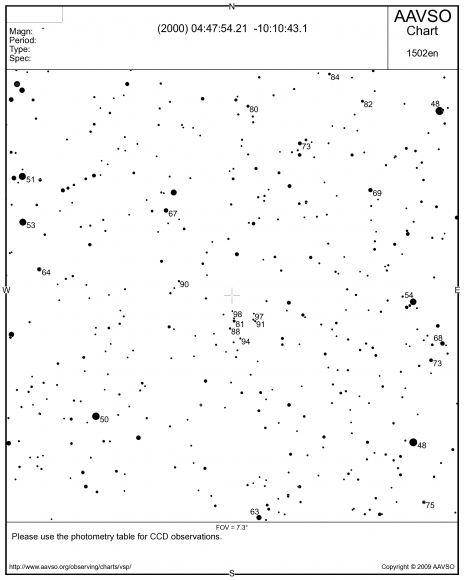
Coordinates: R.A. = 04:47:54.21 Decl. = -10:10:43.1 (equinox 2000.0)
According to CBET No. 2050, "Itagaki notes that there is a faint (mag about 15) object near this position on his archival patrol images. Yamaoka suggests that it might be the brightening of a 15th-mag blue star that is contained in many catalogs (USNO-B1.0 position end figures 54s.19, 42".9), noting that the amplitude of seven magnitudes is rather large for a dwarf nova, but somewhat small for a rapid classical nova. Yamaoka adds that the ASAS-3 system (Pojmanski 2002, Acta. Astron. 52, 397) also detected this object at the following V magnitudes: Nov. 10.236 UT, [14.0:; 19.241, 7.34; 22.179, 7.98; 24.269, 8.12." Finder charts for this object may be plotted using VSP by entering the coordinates into the form at the this URL.
This object has been assigned the VSX identifier VSX J044754.2-101043. An AUID will be assigned by the VSX moderators and will be added to the on-line version of this notice when it becomes available. Please report observations to the AAVSO International Database as N ERI 2009 or VSX J044754.2-101043."
Within 24 hours even more news came in via AAVSO Special Notice #182:
"This new variable object in Eridanus, originally called a possible nova in CBET 2050, is most likely a WZ Sge variable. It matches closely the coordinates of GSC1.2 05325-01837, listed in that catalog at 14.76 mag. At the peak outburst magnitude of 7.3, this is about 7.5 magnitudes amplitude, within the range of a galactic variable and lower than a typical nova. It appears to be fading and is about V=8.5 right now. However, WZ Sge cataclysmic variables have a complex light curve and the star may re-brighten. We are awaiting spectral
confirmation and possible GCVS naming, and will pass on that information as soon as possible.
As mentioned in Special Notice 181, the star has been entered as VSX J044754.2-101043 and now has an AUID of 000-BJR-847. You can submit observations to the AAVSO with either identifier. We have a preliminary sequence from Mati Morel, and have obtained BVRI imagery using the Bright Star Monitor at Astrokolkhoz Observatory
which we will use to construct a multiwavelength sequence tomorrow (November 27).
This is a good target for time series photometry, and at its current brightness, we highly recommend using filters. Larger telescopes should consider B or even U filters."
Congratulations to K. Itagaki on his latest discovery, to AAVSO for pinning it down and to Joe Brimacombe for his quick imaging of the phenomena!